Intelligent Network-Based Control

Fig. 1 Intelligent Space via Network-Based Control.
Project Description:
The main objective of the Intelligent Network-Based Control Project is to develope a wireless unmanned vehicle to find its way through a platform with obstacles. It should arrive at the destination specified by a user in a remote location using the shortest amount of time, and avoiding any collisions.
Main Focuses:
- How to recognize the vehicle and obstacles.
- How to generate a path around the obstacles in the shortest amount of time.
- How network delays contribute to control errors.
The vision of the vehicle is established by a wireless network camera placed on top of the platform. The vehicle is battery operated and completely controlled by wireless communication via IP network. Image processing technology, as well as hardware and software implementations are utilized to demonstrate the path generation and path tracking algorithms. Gain Scheduler Control algorithm may also be implemented in this project to compensate for any network delay disturbance.

Fig. 2 Path generation algorithm.
Publications:
Y. Tipsuwan, M.-Y Chow, “Neural Network Middleware for Model Predictive Path Tracking of Networked Mobile Robot over IP Network,” IEEE IECon’03, Roanoke, VA, Nov 2 – Nov 6, 2003.
Y. Tipsuwan, M.-Y. Chow, “An Implementation of a Networked PI Controller over IP Network,” IEEE IECon’03, Roanoke, VA, Nov 2 – Nov 6, 2003.
Y. Tipsuwan, M.-Y. Chow, “On the Gain Scheduling for Networked PI Controller Over IP Network,” 2003 IEEE/ASME International Conference on Advanced Intelligent Mechatronics, Port Island, Kobe, Japan, July 20-24, 2003.
Y. Tipsuwan, M.-Y. Chow, “Gain adaptation of mobile robot for compensating QoS deterioration,” Proceedings of IECon’02, Sevilla, Spain, November 5 – 8, 2002.
Y. Tipsuwan, M.-Y. Chow, “Network-Based Controller Adaptation Based On QoS Negotiation and Deterioration,” IECon01, Denver, CO, Nov.28-Dec.02, 2001, pp. 1794 -1799.
Y. Tipsuwan, M.-Y. Chow, “Network-based control adaptation for network QoS variation,” MILCOM 2001, October 28-31, 2001, McLean, VA, pp. 257-261.
M.-Y. Chow, Y. Tipsuwan, “Gain Adaptation of Networked Dc Motor Controllers on QoS Variations,” IEEE Transactions on Industrial Electronics, Vol. 50, no. 5, October, 2003.
Y. Tipsuwan and M.-Y. Chow, “Control Methodologies in Networked Control Systems,” Control Engineering Practice, vol. 11, 2003, pp.1099-1111.
M.-Y. Chow, “Methodologies in Time Sensitive Network-Based Control Systems,” 2003 IEEE/ASME International Conference on Advanced Intelligent Mechatronics, Port Island, Kobe, Japan, July 20-24, 2003.
M.-Y. Chow, Y. Tipsuwan, “Real Time Network-Based Control System,” IEEE IECon 2002 Tutorial, Sevilla, Spain, November 5, 2002.
M.-Y. Chow, Y. Tipsuwan, “Network-Based Control Systems: A Tutorial,” Proceedings of IEEE IECon 2001 Tutorial, November 28 – December 2, Denver, CO, pp. 1593 -1602.
Edge detection and HPF based iSpace – Intelligent Space

Project Description:
Intelligent space is a concept which fuses global information using sensors and actuators to take intelligent operational decisions for applications like robot navigation, tele-operation, remote surgery, manufacturing plant monitoring etc. iSpace Concept
ADAC lab has developed a prototype of iSpace as a network based integrated navigation system which is a subset of network based multi sensor multi-large scale actuator mechatronic systems. This whole system is used a research platform for many research topics such as network based control systems, path planning for robot navigation, bandwidth allocation, scheduling, network security, collaborative control.

The focus of this research is path planning navigation for the unmanned ground vehicle in a network based navigation system. Details of the project and the implementations can be found in the dcument section.
Edge Detection

Harmonic Potential Field

Path Planning

Documentations
Predictive Constrained Gain Scheduling for Robot Path Tracking in a Networked Control System


Project Description:
In this project a predictive gain scheduler for robot path tracking control in a networked control system with variable delay is being developed. The controller uses the plant model to predict future position and find the amount of travel possible with the global path as a constraint. Based on variable network conditions and vehicle trajectory’s curvature the vehicle is allowed to travel farther with the same control input as long as the vehicle trajectory matches the path constraint. With this method path specific characteristics are used to evaluate the effectiveness of each generated control signal. By scheduling the gain on the control signal the vehicle tracking performance is maintained with an increase in network delay. The tracking time is decreased compared to other methods since the proposed control method allows controller to look farther down the path to evaluate predicted effect of each control signal before scaling it.
The gain scheduling middleware concept can be illustrated using the diagram below. When controlling a remote system over a network the delay caused by the network affects both the control signal and the feedback signal. When feedback arrives at the controller the feedback signals have been delayed by the network. The feedback preprocessor compensates for this by using the remote system model to predict what the feedback values will be when the next control value arrives. This preprocessed, predicted feedback is used by the controller to generate control commands. In this project the controller is a quadratic curve path tracker.

The control signal is then scaled using a gain table based on certain system parameter such as network delay and path curvature. In predictive constrained gain scheduling the composition of this gain table is uniquely tuned to increase path tracking performance.
Predictive Constrained Motion
When a UGV is tracking a path the motion of the UGV is predicted using the control value and the UGV model. The predicted position is calculated iteratively until the UGV prediction exits a safety region defined around the path. The point where the UGV exits the safety region is the point where the control value loses it’s effectiveness. The predicted position, which is constrained by the future path, is then used to determine how far the UGV is allowed to travel before it needs to get an updated control signal. This distance is then used as another parameter in gain scheduling allowing the UGV to travel further.


When the UGV is allowed to travel further the epsilon value increases. A gain table for scaling control signals is computed for the epsilon value so that the UGV is allowed to travel a distance of epsilon. The gain table will decrease the control signal such that the UGV will not begin to deviate from the path while tracking complex paths with network delay. Several gain tables for different epsilon values can be seen below.

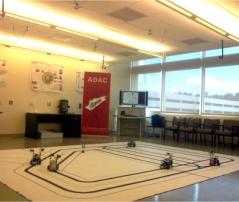
iSpace – Intelligent Space at NC State
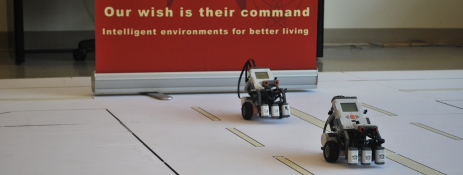
Intelligent Space (iSpace) is a relatively new concept to effectively use distributed sensors, actuators, robots, computing processors, and information technology over communication networks. iSpace is a large scale Mechatronics System by integrating sensors, actuators, and control algorithms in a communication system using knowledge from various engineering disciplines such as automation, control, hardware and software design, image processing, communication and networking.
Documentations