Adaptive Battery Management System Testbed, Summer 2012
About the Project
Students built a fast-prototyping experimental platform for future battery tests. By implementing the battery monitoring algorithms on this PHEV testbed, the algorithms can be evaluated and optimized and thus make PHEV batteries more reliable.
Documentations
Battery Monitoring System

Distributed Cooperative Performance Optimization for Large-scale PHEV/PEV Charging
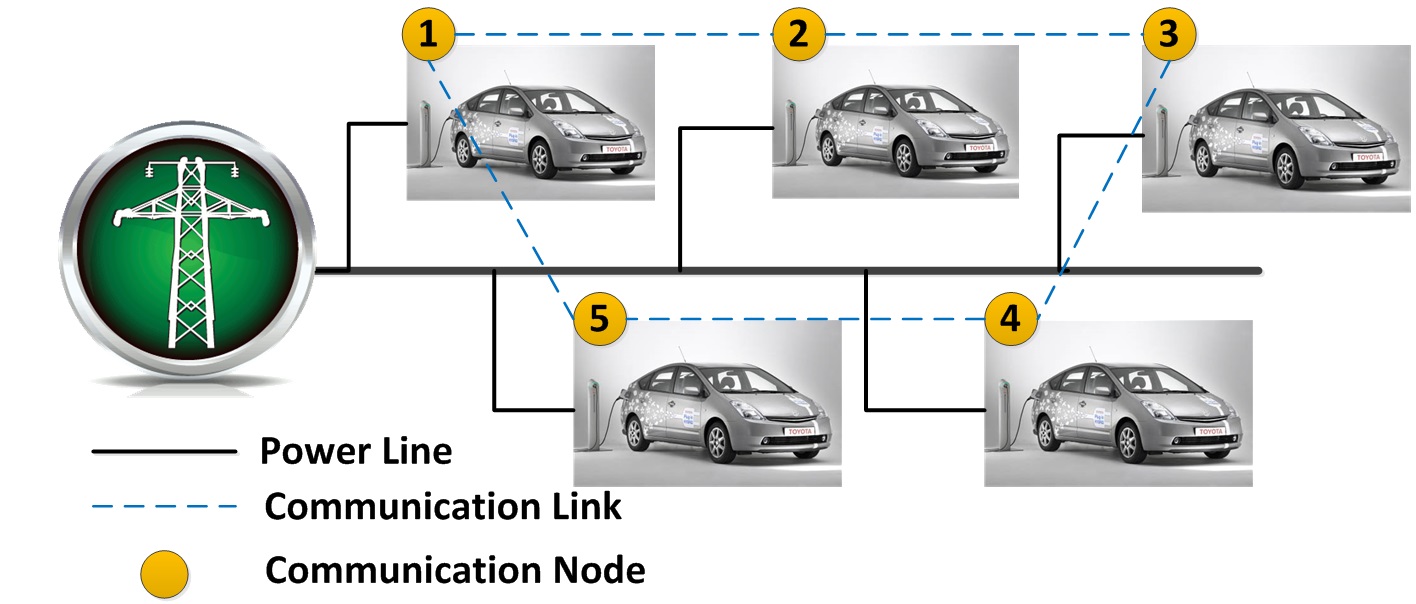
Designing efficient demand management policies for charging Plug-in Hybrid Electrical Vehicles (PHEVs) and Plug-in Electrical Vehicles (PEVs) is becoming a vital issue as increasing numbers of these vehicles are being introduced to the power grid. Since these vehicles utilize grid power for charging, this growth could pose potential threats and benefits for the existing power grid. The main challenge is that when large number of PHEVs/PEVs simultaneously connect to the grid, the overall power system quality and stability could be severely affected due the large amount of power consumption. On the other hand, by smartly controlling the charging process, the utility can utilize the flexible nature of these loads for peak shaving and valley filling to improve the quality of power.
Conventionally, optimal managing of the charging process requires gathering data in a single node and performing a central optimization. However, as the scale of the problem increases to consider thousands of charging stations distributed over a vast geographical area, the central approach would suffer from vulnerability to single node/link failures as well as computational scalability. In this project, the central demand management unit is eliminated and the global optimal power allocation under all local and global constraints is reached by peer-to-peer coordination of charging stations. This approach is highly efficient in terms of computational and communicational effort, considering that the overall demand management problem is large scale and nonlinear. Moreover, using distributed approach, the demand management system gains robustness against single link/node failures.
Publications:
[1] N. Rahbari-Asr and M.-Y. Chow, “Cooperative Distributed Demand Management for Community Charging of PHEV/PEVs Based on KKT Conditions and Consensus Networks,” IEEE Transactions on Industrial Informatics, vol. 10, no. 3, pp. 1907–1916, 2014.
[2] N. Rahbari-asr, M.-Y. Chow, Z. Yang, and J. Chen, “Network Cooperative Pricing Control System for Large-Scale Optimal Charging of PHEVs / PEVs,” in IECON 2013-39th Annual Conference on IEEE Industrial Electronics Society, 2013, pp. 6148–6153.
Links
AIS Gene Library Based Real-Time Resource Allocation on Time-Sensitive Large-Scale Multi-Rate Systems
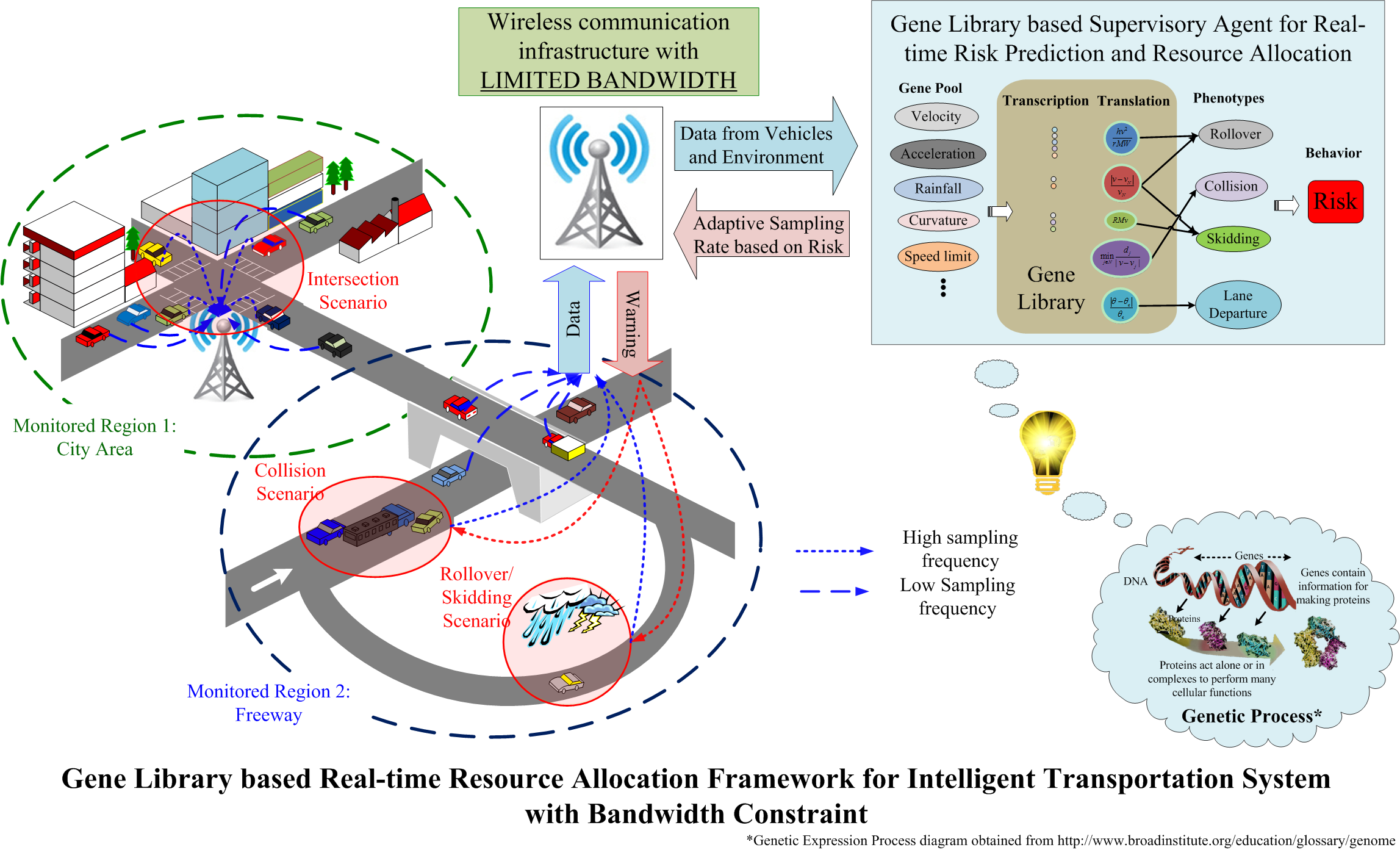
When looking forward towards Intelligent Transportation Systems (ITS), driver warning systems are an integral part of an ITS. There is a need for warning systems that can integrate the information that is currently available in the vehicles with the information about the environment in order to make more informed and accurate decisions. These warning systems should be supported by roadside infrastructures for the acquisition and processing of global/environmental information. In such systems, the roadside infrastructures need to communicate a large amount of time-sensitive data to many of the vehicles. In such a large-scale time-sensitive system, real-time information extraction (e.g. determining the risk for each vehicle) and optimal resource (e.g. bandwidth) allocation are crucial yet computationally demanding.
This project will investigate and develop gene library based real-time information extraction and resource allocation methodology that can be adaptively tuned using the concepts of Artificial Immune System (AIS). This gene library is designed to extract only the relevant information from a vehicle to determine abnormality/risk in vehicle movements at various traffic environments and to provide optimal real-time sampling rate adaptations and emergency interventions based on the information.
Documentations
Links